

Summary: The best coliving spaces combine private accommodation, dependable work facilities, genuine community, and a location that supports your lifestyle. In 2026, the right choice is less about attractive interiors and more about how well a space supports your daily work, privacy, wellbeing, and local experience.
What separates a memorable coliving stay from an expensive shared house? Usually, it is the combination of practical details and human support: a quiet room, reliable internet, comfortable work areas, and people who help you feel settled. If community is central to your decision, our guide to the best communities for digital nomads can help you clarify what type of environment suits you.
Coliving is also responding to wider changes in housing and work. A June 2026 working paper from the U.S. Census Bureau linked remote work with increased migration and residential choices that depend less on proximity to a traditional office. That does not make every shared home a good fit, but it explains why flexibility, work infrastructure, and community are now closely connected.
What makes the best coliving spaces different?
The strongest coliving spaces solve several problems at once. They provide a furnished place to live, reduce the effort involved in setting up utilities and household essentials, and create opportunities to meet people without forcing constant social interaction. The best arrangements also make it possible to retreat when you need concentration or rest.
Look first at the difference between shared living and ordinary room rental. A room in a shared apartment may provide a bed, kitchen access, and a contract. A well-managed coliving space adds hosting, community rituals, maintenance, local guidance, and sometimes coworking facilities. Those additions matter because they shape your daily experience, not only your accommodation.
Affordability is another important reason to examine the model carefully. In March 2026, a Pew Charitable Trusts analysis found that converting obsolete offices into co-living microapartments could produce an average of 3.9 times more affordable homes per dollar of subsidy than building traditional studios across the 10 cities studied. That research concerns housing supply rather than short-term accommodation, but it highlights the model’s potential to use space efficiently.
For a temporary stay, however, low cost alone is not enough. A very cheap space may have weak internet, limited privacy, unclear house rules, or no support when problems arise. Your decision should consider the complete experience, including what is included, what costs extra, and how the space is managed.
Which workspace features matter most for remote work?

Reliable connectivity is the practical foundation of a work-friendly coliving space. Ask whether the internet covers bedrooms and outdoor areas, whether Ethernet connections are available, and whether there is a quiet place for confidential calls. A fast connection is useful, but stable coverage and suitable workstations are often more important than a headline speed.
You should also check the physical setup. Comfortable chairs, appropriate desk height, external monitors, standing desks, power access, and backup arrangements can make a significant difference during a long workday. If you regularly attend meetings, confirm whether calls are permitted in shared areas and whether there are spaces where your voice will not disturb others.
Our coliving examples illustrate why work infrastructure should be assessed alongside the social atmosphere. A space can feel welcoming and still be unsuitable for a demanding schedule if you cannot concentrate, make calls, or maintain a predictable routine.
The ideal arrangement gives you choice. You may work alone in a quiet room, join a shared table for a change of pace, or step outside between tasks. That flexibility supports both deep work and informal collaboration, without requiring you to spend every working hour in the same setting.
How should you compare location, privacy, and community?
Imagine two spaces with similar rooms and prices. One is in a busy city centre, close to restaurants and public transport. The other is in a quieter coastal or countryside setting, with more space and easier access to nature. Neither is automatically better. The right choice depends on how you want your days to feel.
Start by listing your non-negotiables. You may need walkability, an airport connection, shops nearby, or easy access to cafés. Alternatively, you may value a peaceful setting, outdoor activities, and a slower rhythm. The location should support your actual routine rather than an idealized holiday version of your life.
Transport deserves particular attention. A 2026 report from the U.S. Government Accountability Office found that telework has contributed to changing travel patterns and increased demand for real estate outside some city centres. For coliving guests, this reinforces the importance of checking local mobility before booking. Ask whether you need a car, how often public transport runs, and how easily you can reach supermarkets, beaches, or professional meetings.
Privacy should be equally clear. A private bedroom can provide a useful retreat, while shared kitchens and lounges create opportunities for connection. Before you book, verify whether bathrooms are private or shared, how many residents use each communal area, and whether guests can request a room away from high-traffic spaces.
Community is not simply a calendar of events. It is also the presence of a host, the quality of introductions, the respect shown in common areas, and the clarity of house rules. Our POMAR coliving experience is designed around private rooms, shared spaces, on-site hosting, professional work areas, and activities that allow guests to participate at their own pace.
What does value look like in 2026?
Value is not the same as the lowest nightly or monthly rate. It is the relationship between price, convenience, privacy, work quality, and the time you save. A furnished room with internet, housekeeping, workspace access, and community support may cost more than a basic room, but it can reduce the effort involved in building a temporary life from scratch.
Recent renter research also shows why flexibility deserves careful attention. A May 2026 tenant survey reported that 97% of respondents considered price very important, 93% prioritized location, and 57% regarded a flexible lease as a must-have or highly important. The figures come from a survey commissioned by housing operators, so they should be read as indicative rather than universal, but the priorities are relevant when comparing 2026 renter priorities.
Read the booking terms before focusing on amenities. Check the minimum stay, deposit schedule, cancellation deadline, early departure policy, room assignment process, and charges for changes. Also confirm what is included in the base rate. Internet, cleaning, laundry, coworking access, transfers, groceries, and activities may be treated differently from one space to another.
You should also consider the cost of friction. A remote worker who loses several hours arranging a SIM card, finding a desk, buying household supplies, and locating a suitable work venue is paying with time. A hosted space can create value by reducing that friction, provided its services genuinely match your needs.
A practical checklist before you book
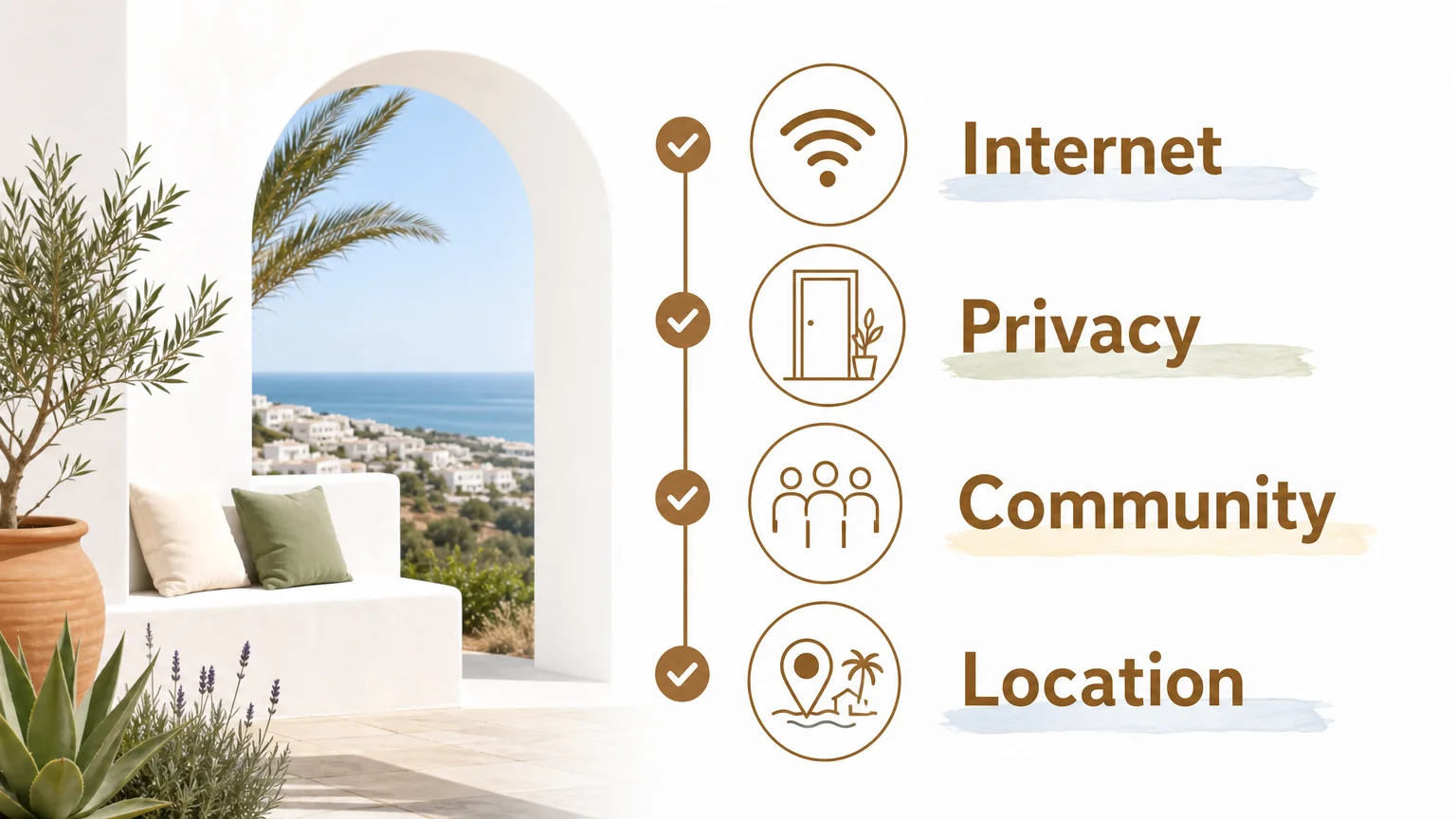
A short checklist can prevent most disappointing bookings. Before committing, ask the following questions:
- Internet: Is the connection reliable throughout the property? Are there suitable spaces for video calls and focused work?
- Privacy: Do you have a private bedroom? How are bathrooms, quiet hours, and room changes handled?
- Community: Is there an active host or community manager? Are dinners, workshops, or activities optional rather than compulsory?
- Location: Can you reach groceries, transport, nature, and local services without unreasonable effort?
- Included services: Does the price cover cleaning, laundry, workspace access, equipment, and basic household facilities?
- Booking terms: What happens if you cancel, shorten your stay, arrive late, or need to change dates?
Reviews can help, but read them for evidence rather than adjectives. Look for comments about internet reliability, noise, cleanliness, host responsiveness, room accuracy, and the gap between advertised community life and the actual experience. Recent reviews are especially useful when the space has changed managers, locations, or operating seasons.
You should also ask whether the community suits your energy. Some spaces are highly social, while others are quieter and more independent. If you prefer a balance, choose a place with shared activities and private rooms, rather than assuming that every communal home offers the same level of interaction.
Is coliving better than renting?
Coliving is usually more convenient for a temporary move, a workation, or a period when you want community without building a household from the beginning. Traditional renting can be more suitable when you need long-term control, complete privacy, space for children, or permission to bring pets.
The key difference is the service model. Renting generally gives you a property and places more responsibility on you. Coliving may include furniture, utilities, housekeeping, work facilities, hosting, and social programming. In exchange, you accept shared spaces, house rules, and less control over the wider household environment.
Our guide to coliving versus renting explains the trade-offs in more detail. The important point is to choose according to your time horizon and priorities, not according to the label alone.
For example, POMAR’s standard coliving arrangement is built around private rooms in shared homes, professional coworking areas, high-speed fiber broadband, housekeeping, laundry access, fitness and wellness options, community dinners, workshops, and local activities. Families or guests travelling with pets should review the accommodation rules carefully, since standard shared coliving is not designed for children or pets.
Choose the space that supports your whole routine
The best coliving spaces are not defined by attractive photographs alone. They give you a dependable place to sleep, work, recover, and connect, while making the practical details of temporary living easier. Compare internet quality, privacy, host support, community style, transport, included services, and booking terms before you decide. When those elements fit your real routine, coliving can become more than flexible accommodation. It can become a stable base for productive work and meaningful local experience.
Take action with POMAR coliving
If you are looking for a temporary base that combines focused work with community and Algarve life, your next step is to compare the setting, room format, work facilities, and support available during your stay.

At POMAR, private-room coliving is supported by shared living areas, professional coworking spaces, fiber broadband, ergonomic equipment, on-site hosts, housekeeping, wellness options, community dinners, workshops, and organized local activities. Explore coliving in the Algarve and review the current availability, terms, and location that best match your plans.
Frequently Asked Questions
What should you look for in the best coliving spaces?
Look for reliable internet, a private and comfortable room, suitable work areas, clear house rules, responsive hosting, and a community that matches your preferred level of social interaction. You should also verify the location, included services, minimum stay, and cancellation terms.
Is coliving suitable for remote workers?
Yes, when the space provides stable connectivity, ergonomic workstations, quiet areas, and practical support for calls and focused tasks. It can also reduce the isolation that some remote workers experience when they move between short-term rentals.
Are coliving spaces private?
Many coliving spaces provide private bedrooms with shared kitchens, lounges, work areas, or bathrooms. Always confirm the exact room arrangement, resident capacity, quiet hours, and room-change policy before booking.
Can you stay at POMAR for coworking without booking accommodation?
POMAR provides coworking access for day users, subject to advance booking and available capacity. Contact the team before arriving to confirm access, current terms, and the work facilities available on your chosen date.
Is coliving cheaper than renting an apartment?
It can reduce upfront costs because furniture, internet, utilities, cleaning, and shared facilities may be included. However, the overall value depends on the length of your stay, the services included, the level of privacy, and the local rental market.