

Summary: Effective board retreat planning starts with a clear purpose, measurable outcomes, and early input from the people who will participate. A focused agenda, suitable facilitator, practical venue, and documented follow-up can turn a retreat from an extended meeting into a meaningful governance and strategy session.
A successful retreat should help your board make progress that regular meetings cannot accommodate. The right setting can create space for deeper conversations, stronger relationships, and clearer decisions, whether you are reviewing strategy, clarifying governance, or addressing a major organizational challenge. If you are considering an Algarve setting, our Algarve retreats can provide a work-focused environment away from routine distractions.
The challenge is not simply finding a pleasant location. It is designing a process that respects participants’ time and produces useful outcomes. In July 2026, BoardSource guidance described a retreat setting as particularly suitable for larger strategic discussions and stronger interpersonal dynamics among board members.
What must the retreat accomplish?
Begin with the question, “What must be different when the retreat ends?” A broad intention such as “improve alignment” is useful, but it is not specific enough to guide the agenda. Convert that intention into a short purpose statement that identifies the central work.
Your retreat might aim to agree on three strategic priorities, review the board’s composition, clarify fundraising expectations, prepare for leadership succession, or strengthen the relationship between the board and executive team. It may address several of these subjects, but the retreat should have one central thread. Three or four measurable outcomes are usually easier to manage than a long list of ambitions.
For each outcome, define what evidence of progress will look like. If the board is reviewing strategy, the result might be a short list of agreed priorities and decision criteria. If the focus is governance, the outcome might be a plan for committee development, recruitment, or board self-assessment.
Keep the purpose distinct from the event format. An overnight retreat is not automatically more strategic than a half-day workshop. The format should serve the work, not determine it.
How can you involve the board before the day?
Ask board members for input before you draft the final agenda. A short survey or structured conversation can reveal concerns that may not appear during regular meetings. It also creates pre-retreat input, which helps participants feel that the event belongs to the whole board rather than to one organizer.
Useful questions include:
- What would make this retreat valuable for the organization?
- What would make it valuable for you personally?
- Which strategic issue requires more time than a regular meeting allows?
- What decision, agreement, or action should result?
- What information would help you participate fully?
The board chair and executive director should review the responses together. Their role is to identify common themes, separate strategic questions from operational concerns, and decide which topics belong on the retreat agenda. When sensitive issues emerge, address them directly rather than hiding them beneath general language.
Send essential materials early. Depending on the purpose, these may include the current strategic plan, financial summaries, a board assessment, stakeholder feedback, governance policies, or a concise environmental scan. Avoid sending a large document package without guidance. Tell participants what to read, what to consider, and what questions they should bring.
Participation also improves when practical expectations are clear. Explain the start and end times, preparation required, dress considerations, technology arrangements, dietary process, and whether part of the event will involve walking or informal discussion.
Can your agenda create decisions, not just discussion?
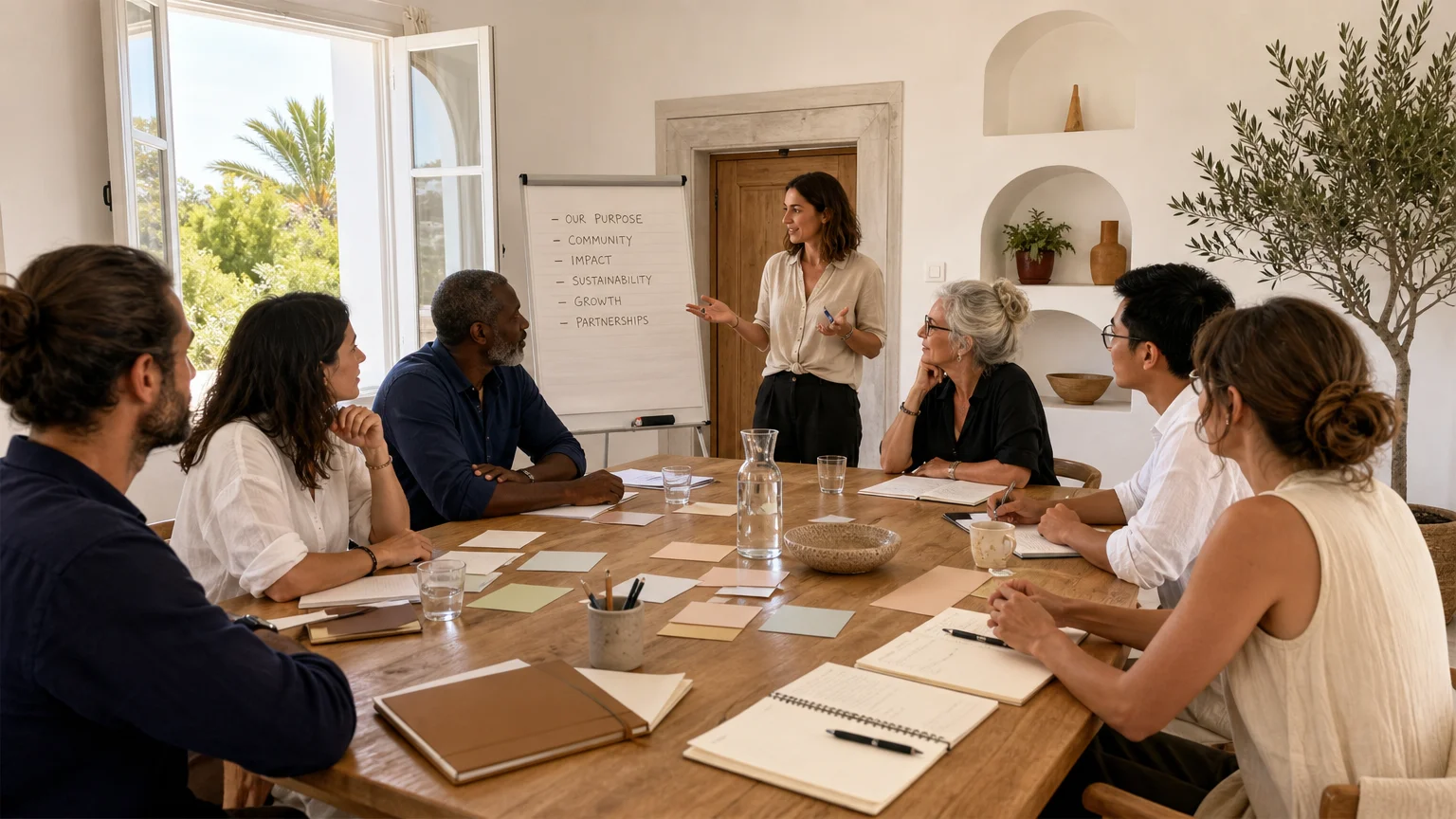
A strong agenda creates movement from context to insight, from insight to choice, and from choice to commitment. It should not be a longer version of the usual board meeting. Routine reports, extensive approvals, and updates that could be read in advance often consume the time needed for strategic work.
Organize the day around the outcomes you defined. A practical sequence might look like this:
| Session | Purpose | Expected output |
|---|---|---|
| Welcome and context | Reconnect participants with the mission and explain the day’s purpose | Shared expectations and working norms |
| Current position | Review relevant evidence, progress, risks, and external changes | Common understanding of the situation |
| Strategic challenge | Explore the central issue through facilitated discussion | Options, assumptions, and decision criteria |
| Small group work | Give participants space to test ideas and surface different perspectives | Recommendations or priority actions |
| Governance and roles | Clarify responsibilities between the board, chair, executive, and staff | Clear boundaries and expectations |
| Action planning | Translate agreements into assigned next steps | Owners, dates, and progress checkpoints |
Protect time for small group discussion. Some board members may contribute less in a large room, particularly when the topic is sensitive or the group includes strong personalities. Smaller conversations can surface concerns earlier, provided each group receives a precise question, a time limit, and a clear reporting format.
Include breaks and informal time without allowing them to overwhelm the agenda. A shared meal, short walk, or unstructured conversation can support trust. The purpose is not entertainment. It is to create the relationships that make candid and constructive disagreement possible.
Who should facilitate the work?
Consider the facilitator’s role carefully. The person who keeps time and moves between agenda items is not necessarily the person who can guide a difficult strategic conversation. A retreat facilitator should help the group listen, challenge assumptions, identify patterns, and reach decisions.
An external facilitator can be valuable when the board is discussing executive performance, board composition, internal conflict, succession, or another subject involving strong personal interests. An outside professional also allows the chair and executive director to participate fully rather than manage the room.
Internal facilitation can work when the purpose is straightforward and the group has a strong culture of respectful discussion. If you choose this route, appoint someone who is neutral enough to guide the process. The chair should not have to lead every discussion, defend a position, monitor participation, and capture decisions at the same time.
Before selecting a facilitator, ask about their approach to preparation, group dynamics, difficult conversations, accessibility, documentation, and follow-up. Request a clear description of what is included. Facilitation, event coordination, and venue management are different responsibilities, and one person may not provide all three.
Which format and venue fit the objective?
The venue should reduce friction and support concentration. You need more than attractive surroundings. Consider privacy, acoustics, seating, accessibility, temperature control, breakout areas, reliable connectivity, food service, transportation, and a quiet place for informal conversations.
| Format | Suitable when | Main consideration |
|---|---|---|
| Half day | The board needs to resolve one focused issue or complete a short assessment | Limit the agenda to one or two outcomes |
| Full day | The retreat combines strategy, governance, and relationship building | Protect breaks and avoid excessive presentations |
| Day and overnight | The board needs deeper discussion, significant trust-building, or travel time | Separate meaningful informal time from unnecessary programming |
| Virtual or hybrid | Travel is impractical or board members are spread across locations | Use shorter sessions, tested technology, and deliberate breakout design |
For an international group, travel time and time zones may influence the decision as much as the agenda. A destination retreat can help participants disconnect from daily routines, but the location must remain practical for the people expected to attend.
When you need a venue that combines accommodation with work-ready facilities, our remote team meeting venue in the Algarve can support focused group sessions, professional events, and retreat arrangements. We provide high-speed fiber broadband, Wi-Fi coverage, Ethernet access, ergonomic work equipment, and on-site hosting. We can discuss partial or complete house arrangements, with capacity depending on the setup, room availability, and group requirements.
We can also help coordinate local logistics, meals, activities, and informal programming through direct consultation. These arrangements vary by group and season, so confirm the scope, costs, accessibility details, cancellation conditions, and technical setup before booking.
What governance details deserve protection?
A retreat may feel less formal than a regular meeting, but it can still involve official board business. Determine whether your bylaws, governing documents, or applicable law treat the event as a board meeting. This is especially important if a quorum will be present, formal votes will occur, or the board will approve a resolution.
Rules vary by jurisdiction, so international organizations should obtain local legal advice when necessary. In the United States, the National Council of Nonprofits explains that board minutes guidance treats minutes as important legal and institutional records. Your organization should therefore decide in advance what must be documented and who will maintain the record.
If the retreat includes formal action, document attendance, quorum, motions, votes, abstentions, conflicts of interest, and decisions. If it is an informal planning session, you may still want a concise record of themes, agreements, unresolved questions, and assigned actions.
Keep the board and staff roles clear. The board should focus on mission, strategy, oversight, risk, resources, and governance. Staff should provide operational insight and implementation expertise. A retreat can strengthen collaboration without turning board members into operational managers.
Accessibility deserves equal attention. Ask participants about mobility, hearing, vision, dietary, communication, and caregiving needs early enough to make practical adjustments. A retreat cannot be fully participatory if someone cannot access the room, follow the discussion, or remain present comfortably.
How will the work continue after everyone leaves?
The final hour should be protected for action planning. Do not end with general agreement or a collection of unassigned ideas. Select the most important outcomes, identify the first step for each, and assign one named owner.
A useful action record includes:
- The agreed outcome or decision
- The first practical step
- One accountable owner
- The support required from others
- A completion date or review date
- The next board meeting where progress will be discussed
A 2026 survey of board-connected professionals found that 87% of respondents reported at least one ineffective board member. That result describes survey respondents rather than all boards, but it highlights why clear roles, preparation, and follow-through matter. You can review the findings in the 2026 board survey.
Send a concise retreat summary within one week. Include the decisions, the reasoning behind them, the action owners, and the next checkpoint. Avoid distributing unedited notes that force participants to reconstruct the conversation themselves.
At each subsequent board meeting, reserve a short progress review. Ask what has moved, what is blocked, and what support is needed. If an action no longer fits the organization’s priorities, revise it openly. Follow-up is not a compliance exercise. It is the mechanism that turns a productive conversation into governance progress.
Make the retreat worth the time
Effective board retreat planning begins long before participants enter the room. Define a small number of outcomes, invite input, create an agenda that supports real decisions, and select a facilitator and venue that match the work. Protect governance responsibilities, accessibility, and participant energy throughout the day. Most importantly, finish with named owners and review dates. A retreat becomes valuable when its conclusions continue shaping decisions after everyone returns to regular responsibilities.
Plan a Focused Board Retreat in the Algarve
Once the purpose, agenda, and follow-up process are clear, the setting should make participation easier rather than add logistical complexity. A hosted environment can give your board room to work, reflect, and connect away from its usual meeting routine.
We combine private accommodation, professional workspaces, high-speed connectivity, on-site hosting, and optional local activities for professional groups. To discuss dates, group size, format, and practical requirements, explore our Algarve coliving retreat venue.
Frequently Asked Questions
What is the purpose of a board retreat?
A board retreat creates dedicated time for strategic discussion, governance development, relationship building, or leadership alignment. It should produce clear outcomes that regular board meetings cannot address adequately.
How long should a board retreat last?
The right duration depends on the objectives, travel requirements, budget, and participants. A focused half-day may be sufficient for one issue, while a full day or overnight format can support deeper work.
Who should attend a board retreat?
The board should usually attend with the executive director or chief executive. Selected senior staff, subject experts, or an external facilitator may join specific sessions when their contribution supports the retreat’s purpose.
Does every board retreat need an external facilitator?
No, but an external facilitator can help when the group must discuss sensitive issues or when the chair needs to participate fully. Internal facilitation can work when the objectives are clear and the facilitator can remain neutral.
Can POMAR host a board retreat?
Yes, we can discuss professional events, seminars, retreats, and partial or complete house arrangements in the Algarve. Capacity, setup, activities, catering, and pricing depend on the group’s requirements and availability.