

Summary: Planning a leadership retreat works best when every decision supports a defined business outcome. Set two or three measurable objectives, choose a private and practical venue, balance strategic work with recovery, prepare participants properly, and document decisions with owners and deadlines before everyone leaves.
A leadership retreat should create more than a change of scenery. It should give your team the time, privacy, and structure needed to resolve important questions. If you are also considering governance, decision-making, or board-level alignment, our board retreat planning guide can help you frame those conversations.
The context for retreats is changing in 2026. Guidance from Cvent’s 2026 retreat guidance points toward smaller, more frequent offsites rather than relying only on one large annual gathering. For leadership teams, that makes careful prioritisation essential: a focused two-day retreat can be more useful than an ambitious itinerary that tries to solve every organisational issue at once.
What must be different after the retreat?
Begin with the end state, not the destination. A retreat deserves approval only when you can explain what should be clearer, decided, or different when participants return to work.
Choose one primary objective and no more than two supporting objectives. Common primary aims include agreeing on strategic priorities, resolving tension between functions, clarifying leadership responsibilities, preparing for organisational change, or creating a practical operating plan for the next quarter.
Turn each objective into a visible output. A useful output might be a prioritised roadmap, a list of initiatives to stop, a decision on resource allocation, or a leadership agreement with named owners. Avoid vague goals such as “improve communication” unless you define the behaviour or decision that will demonstrate progress.
| Retreat aim | Useful measure | Expected output |
|---|---|---|
| Strategic alignment | Leaders rank the same priorities | Three to five agreed priorities |
| Decision-making | Open questions receive clear owners | Decision log with deadlines |
| Leadership cohesion | Participants identify and address key tensions | Working agreements and follow-up actions |
| Organisational change | Leaders understand their responsibilities | Communication and implementation plan |
Write these outcomes into a one-page retreat brief. Include the purpose, participants, dates, budget range, non-negotiable requirements, and decisions that must be made. This brief becomes your filter when someone proposes another activity, presentation, or destination.
Who needs to be in the room, and what do they need?
A smaller group does not automatically create better discussion. The right participants are those who hold the information, authority, or responsibility needed to reach the retreat’s objectives.
Invite the people who must implement the decisions, not only the people who approve them. Depending on the topic, this may include the executive team, functional leaders, a chief of staff, a people leader, or a subject matter expert. Be explicit about whether each person is a decision-maker, contributor, observer, or facilitator.
Participant needs should shape the design before the venue is booked. Ask about mobility requirements, dietary restrictions, travel constraints, preferred working formats, accessibility, quiet time, and any concerns about confidentiality. A short pre-retreat survey can reveal practical issues that are easy to miss during internal planning.
Preparation also matters. Send concise pre-reading seven to fourteen days before arrival, including the decisions to be addressed and the information participants must review. Do not use retreat time to present material that could have been read in advance. Instead, reserve the room for interpretation, debate, scenario planning, and commitment.
Your communication should explain why attendance matters, what preparation is expected, and how candid discussion will be handled. If you are shaping a broader people-focused event around the leadership retreat, our staff retreat theme ideas can also help you explore different formats for connection and participation.
Does the venue support the work your leaders must do?

The venue determines how easily people can concentrate, speak honestly, and recover between sessions. Choose it after defining the objectives, because a strategy retreat, a leadership development retreat, and a relationship-focused offsite require different environments.
Evaluate five practical dimensions:
- Privacy: Can confidential conversations happen without outside interruptions?
- Work infrastructure: Are the internet connection, screens, whiteboards, power, seating, and call spaces suitable for the agenda?
- Accessibility: Can participants reach the venue without unnecessary travel complexity?
- Accommodation: Will people have enough personal space to rest properly?
- Atmosphere: Does the setting encourage focus while still allowing informal connection?
Do not confuse a beautiful venue with a useful one. Ask for room dimensions, seating layouts, sound conditions, internet details, equipment availability, meal arrangements, cancellation terms, and weather alternatives. If participants will work remotely for part of the retreat, confirm the technology before signing a contract.
Our Algarve locations in Estoi and Olhão are designed around temporary living, coworking, hosted community, and focused work. We can discuss professional events, seminars, offsites, remote team meetings, and related group arrangements through direct consultation. For groups that need more privacy, we can also explore partial or complete house privatization, subject to the specific brief and availability.
Our workspaces include fiber internet, Wi-Fi coverage, ergonomic seating, screens, standing desks, conference-call space, Ethernet sockets, and backup power at workstations. If you are comparing destinations for a distributed team, our Algarve remote team meeting venue resource provides a more focused way to assess the setting.
How should you balance strategy, connection, and recovery?
A productive retreat feels purposeful without becoming an extended meeting. Design the agenda around energy, not just available hours.
Place the most demanding strategic work when participants are alert. Use ninety-minute or two-hour blocks, then add short breaks that allow people to process the discussion. Mix plenary sessions with pairs or small groups, especially when the subject requires reflection before full-group debate.
A practical rhythm for a two-day retreat might include:
- An opening session that confirms the purpose, ground rules, and desired decisions.
- A deep work block focused on the primary strategic question.
- A shared meal with informal conversation rather than another presentation.
- A second work block using breakouts, scenarios, or prioritisation exercises.
- Protected time for rest, individual reflection, or optional local activities.
- A closing session that confirms decisions, owners, deadlines, and unresolved issues.
Connection activities should support the objective rather than interrupt it. A facilitated walk, shared meal, creative workshop, or short problem-solving exercise may work better than a compulsory game. Offer options when participants have different physical abilities, comfort levels, or interests.
In 2026, the case for recovery time is also practical. A 2026 retreat report based on a survey of 1,040 U.S. travelers found that 62% named rest and relaxation as their main retreat motivation. This is traveler data, not a corporate leadership benchmark, but it reinforces an important planning principle: people think more clearly when the schedule leaves room to recover.
Where do retreats quietly fail?
Most operational problems begin before arrival. A missing transfer, unclear room assignment, unsuitable meal, weak internet connection, or absent weather plan can distract leaders from the work they travelled to complete.
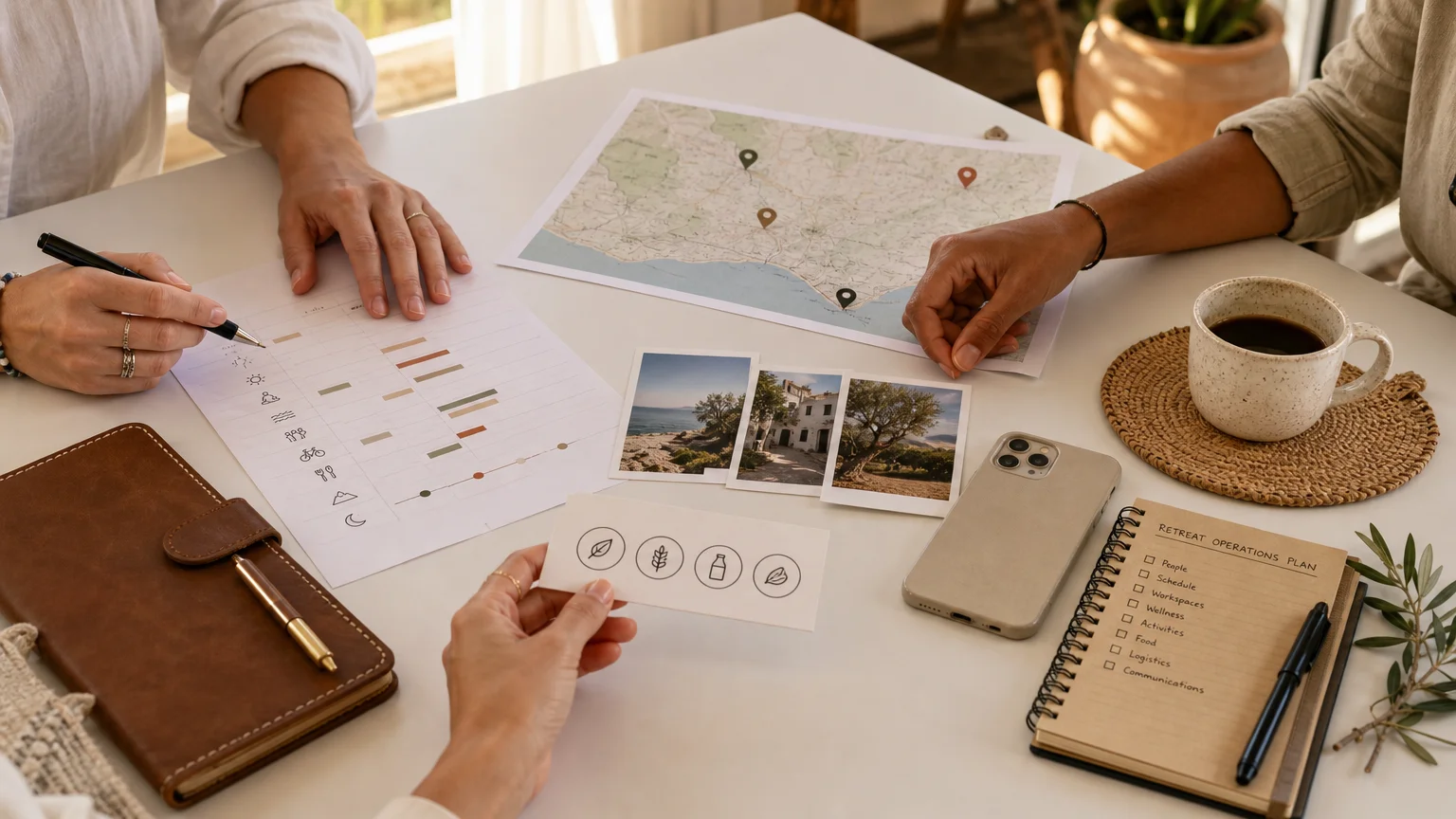
Create one shared logistics document with an owner for every task. Include accommodation, travel, transfers, meals, technology, room setup, activity bookings, emergency contacts, and contingency actions. A checklist without ownership is only a list of intentions.
Travel planning should include delayed arrivals, early departures, accessibility requirements, and a clear contact method. Send participants a final logistics note with arrival instructions, packing guidance, the agenda, dietary confirmations, emergency contacts, and expectations around technology use.
Technology deserves a separate test. Confirm presentation formats, video-call access, adapters, power availability, screen visibility, microphones, and backup options. If the retreat includes remote participants, decide whether they are genuinely included or merely watching an in-room conversation. Hybrid participation requires dedicated facilitation and equipment.
Budget for the complete experience, not only the room rate. Include transport, meeting space, catering, facilitator fees, activities, materials, taxes, cancellation exposure, and a contingency reserve. A 2026 survey from 111 in-house corporate event professionals found that 79% had seen costs rise by at least 5%, while 47% reported flat budgets and 19% reported budget cuts, as detailed in the Skift Meetings survey.
Review contracts carefully. Confirm deposit schedules, cancellation deadlines, force majeure language, minimum spend, room release dates, supplier restrictions, and responsibility for changes caused by weather or transport disruption. These details protect the retreat’s purpose when circumstances change.
When should you use a facilitator?
Facilitation is especially useful when the retreat involves disagreement, sensitive information, a new leadership team, organisational restructuring, or decisions in which the chief executive has a strong personal stake.
An internal leader may facilitate a straightforward planning session effectively. However, asking one executive to manage the process while also defending a proposal can limit candid discussion. An external facilitator can hold the structure, surface quieter perspectives, challenge circular debate, and keep the group focused on decisions.
Choose a facilitator based on process skills, relevant leadership experience, neutrality, confidentiality, and the ability to adapt in the room. Clarify whether the engagement includes participant interviews, agenda design, pre-reading, on-site facilitation, decision documentation, and follow-up support.
Set discussion rules at the beginning. Useful agreements include confidentiality, equal participation, respectful challenge, evidence-based debate, clear decision rights, and a commitment to distinguish disagreement from personal criticism.
Activities should also be designed with care. A short speed-mentoring exercise, structured peer feedback, scenario planning, or rotating small-group discussions can create useful insight without forcing artificial intimacy. The best activity is the one that helps participants address the retreat’s real objective.
What happens after everyone goes home?
The retreat is not complete when the final meal ends. Its value depends on how quickly ideas become decisions, responsibilities, and visible action.
Within three to five working days, circulate a concise record. Include decisions made, decisions deferred, unresolved questions, owners, deadlines, and any assumptions that require validation. Do not distribute an exhausting transcript. Provide the information people need to act.
Translate the results into existing management systems. Add agreed priorities to operating plans, assign executive sponsors, update project milestones, and schedule the first review before momentum fades. A thirty-day check-in can confirm progress, while a ninety-day review can assess whether the retreat changed execution.
Collect feedback while the experience is still fresh. Ask whether the objectives were clear, whether the agenda supported meaningful work, whether participants felt heard, and what should change next time. Combine these responses with objective indicators, such as decisions completed, delayed projects resolved, or leadership agreements adopted.
If the retreat includes capability building, learning design, or individual growth, our professional development retreat resource can help you connect the agenda to longer-term development outcomes.
How can you tell whether the retreat worked?
Success should be assessed against the original purpose, not against whether participants enjoyed the destination. Enjoyment matters, but it is not the primary measure for a leadership retreat.
Use a simple scorecard with three levels. First, assess immediate outputs: were the planned decisions made, and were owners assigned? Second, assess behavioural follow-through: did leaders communicate the decisions and change their working practices? Third, assess business relevance: did the retreat improve focus on priorities, accelerate execution, or reduce recurring disagreement?
Invite participants to describe one decision they now understand better, one relationship that improved, and one action they will take. This combination of qualitative feedback and measurable follow-through gives you a more honest picture than a satisfaction score alone.
Finally, record what should be repeated and what should be removed. Over time, these notes become an internal retreat playbook. The next planning cycle becomes faster because your organisation has learned which formats, venues, preparation methods, and facilitation approaches produce useful decisions.
Make the retreat earn its place on the calendar
Planning a leadership retreat is a strategic exercise, not simply an event booking task. Define the outcomes first, involve the right people, select a venue that supports confidential work, protect recovery time, and treat logistics as part of the leadership experience. When every session ends with clarity, ownership, or a better question, the retreat can continue influencing decisions long after the group returns home.
Plan Your Leadership Retreat in the Algarve
If your leadership team needs focused work, private accommodation, and time away from daily operations, we can help you explore a retreat format that matches your objectives. Our Algarve locations support professional events, seminars, offsites, remote team meetings, and selected group arrangements through direct consultation.
We combine private rooms, coworking infrastructure, shared living areas, on-site hosting, and optional wellness or outdoor experiences. Discuss coliving in the Algarve for your leadership retreat with our team and outline your preferred dates, group size, work requirements, and privacy needs.
Frequently Asked Questions
How far in advance should you plan a leadership retreat?
Begin planning three to six months ahead for a small leadership group, and earlier for international travel, exclusive-use venues, or external facilitators. This gives you time to coordinate senior calendars, compare contracts, prepare participants, and develop meaningful content.
How long should a leadership retreat last?
One and a half to two days suits many focused leadership retreats, while broader strategic planning may require two or three days. The right duration depends on the number of decisions, travel time, preparation level, and amount of recovery time you want to protect.
What should be included in a leadership retreat agenda?
Include an opening context session, focused strategic work, structured discussion, breaks, informal connection, optional recovery time, and a closing review of decisions. Every major session should have a defined purpose and an expected output.
Should you hire an external facilitator?
An external facilitator is useful for sensitive topics, conflict, restructuring, new leadership teams, or situations where the chief executive needs to participate fully. Internal facilitation can work when the objectives are straightforward and the person leading the process can remain neutral.
Can POMAR support a leadership retreat in the Algarve?
Yes, we can discuss professional events, seminars, offsites, remote team meetings, and related group arrangements at our Algarve locations. We can also explore partial or complete house privatization, coworking requirements, accommodation, and optional local activities through direct consultation.