

Summary: Co-living housing combines a private bedroom with shared living areas, services, and community, often under a more flexible arrangement than a conventional rental. It can suit remote workers, entrepreneurs, students, creatives, and people settling into a new city, but it requires comfort with shared routines, house rules, and reduced control over communal spaces.
Could a home give you privacy, reliable work infrastructure, and a ready-made social circle without the weight of a conventional lease? That is the promise behind co-living housing, and our co-living versus renting guide helps you compare both models through practical criteria.
Unlike an ordinary house share, co-living is usually designed around a complete experience. Furnished rooms, shared amenities, cleaning, internet, events, and flexible terms may be coordinated by one operator. The result can be convenient and social, although the quality of the experience depends on management, house culture, location, and the expectations you bring.
What is co-living housing, exactly?
Co-living housing is a residential arrangement where unrelated residents have private bedrooms and share spaces such as kitchens, lounges, gardens, work areas, or fitness facilities. A professional operator commonly manages the property, coordinates services, and establishes expectations for communal life.
The model sits between several familiar options. Traditional roommates may share rent and chores, but they often organize the household themselves. A hostel generally focuses on short stays and shared sleeping areas. Co-housing usually involves more permanent homes and intentional collective decision-making. Co-living typically offers a private room, furnished surroundings, shared facilities, and a more structured community experience.
For a clearer explanation of the terminology, you can read our guide to what co-living means. The central idea is simple: you rent access to both a personal space and a shared living environment, rather than renting an empty unit and building the entire experience yourself.
Why is co-living housing gaining attention in 2026?
One important figure explains part of the demand. In 2024, approximately 40% of renter households in the United States consisted of one person, according to Pew analysis. Many individuals need a home that is affordable, furnished, connected to employment, and suitable for modern routines.
In 2025, Pew and Gensler examined whether vacant offices in 10 United States cities could be converted into small co-living apartments. The proposal reflected a broader mismatch between available housing and the needs of people seeking lower-cost homes near jobs and amenities.
This does not mean every co-living space is inexpensive. Prices vary according to location, room size, services, lease length, and the quality of the shared facilities. However, the model can reduce several costs at once, including furniture purchases, utility setup, brokerage fees, cleaning arrangements, and the time required to find compatible housemates.
Co-living also responds to social needs. Moving to a new city can create isolation, particularly when you work remotely or travel frequently. A well-managed home gives you opportunities to meet people naturally through shared meals, workshops, interest groups, and informal conversations.
What should a well-designed co-living home include?
Picture a Monday morning in a carefully planned shared home. You have a quiet private room, a reliable desk, a place for calls, a kitchen that is ready to use, and people nearby without an obligation to socialize constantly. That balance is more important than decorative design alone.
Privacy begins with the room. A private bedroom allows you to rest, take personal calls, and step away from communal activity. Some homes also provide private bathrooms, lockable storage, or acoustic separation. These details matter when your stay lasts several weeks rather than several nights.
Work infrastructure is equally important for remote workers and entrepreneurs. Look for dependable broadband, strong Wi-Fi coverage, ethernet access, ergonomic seating, suitable lighting, conference-call areas, and backup options when connectivity fails. A beautiful kitchen cannot compensate for unreliable internet when your income depends on online work.

Shared facilities should support ordinary life, not merely photograph well. Useful features may include laundry access, housekeeping, outdoor areas, fitness equipment, quiet corners, and a kitchen large enough for several residents. The operator should also explain how cleaning, maintenance, waste, visitors, and noise are handled.
At POMAR, we connect private-room accommodation with professional coworking spaces, fiber broadband, ergonomic equipment, on-site hosts, wellness options, and community programming. The purpose is to make shared living practical for focused work, recovery, and meaningful social contact.
Who benefits from co-living, and who may not?
Would you enjoy meeting new people several times a week, while still having a room where you can close the door? If the answer is yes, co-living may fit your lifestyle. If you strongly prefer complete control over common areas, visitors, sound, and household routines, a private apartment may feel more comfortable.
Co-living often suits remote workers who need a temporary base with dependable connectivity. It can also work well for entrepreneurs, freelancers, creatives, students, and professionals relocating for a project. These residents may value flexibility, furnished accommodation, and access to people with different skills and experiences.
Digital nomads often choose co-living because it reduces the effort involved in repeatedly arranging housing. Instead of booking an isolated apartment, they can arrive at a prepared home with local contacts and a social starting point. A 2026 market forecast from Fortune forecast describes the sector as serving working professionals, students, expatriates, travelers, and digital nomads.
Co-living is less suitable when you need complete solitude, have highly specific household habits, or cannot compromise on shared responsibilities. Families, children, and pets may also face restrictions in standard arrangements. For example, POMAR’s shared coliving format does not accommodate children or pets, while complete house privatization can provide a different arrangement for eligible groups.
Community should also be evaluated carefully. A calendar of events does not automatically create belonging. The quality of hosting, the tone of communication, and the freedom to participate at your own pace are more meaningful indicators. For more context, explore our article on the importance of community.
How does co-living compare with traditional renting?
Consider the first week after moving into an unfurnished apartment. You may need to buy furniture, arrange internet, purchase kitchen equipment, manage utilities, and find ways to meet people. Co-living can remove several of those tasks by combining them within one managed arrangement.
Traditional renting usually provides greater independence. You control the home, choose your furniture, set your routines, and decide who visits. It may also offer stronger long-term stability, especially when you want to settle in one location for several years.
Co-living usually provides greater convenience. Furniture, utilities, internet, shared equipment, cleaning, and community activities may be included or arranged through one operator. Flexible terms can also help when your work contract, travel plans, or relocation timeline is uncertain.
The trade-off is control. You may have less influence over communal decoration, shared schedules, visitor policies, and the habits of other residents. You may also pay a premium for management, convenience, and included services compared with a basic room in an informal house share.
The right comparison is therefore not simply rent against rent. Compare the complete monthly cost, the time saved, the quality of the work environment, the level of privacy, the cancellation terms, and the social experience. A lower price is not useful if the location makes commuting difficult or the workspace prevents you from working effectively.
What should you check before booking a co-living space?
What happens after you pay the deposit matters as much as the photographs. Before booking, examine the practical details that shape your daily experience.
- Room privacy: Confirm whether the room is private, whether the bathroom is shared, and whether locks, storage, and noise separation are provided.
- Internet quality: Ask about the connection, Wi-Fi coverage, ethernet access, workspace availability, and suitable areas for private calls.
- House culture: Check how residents communicate, how events are organized, and whether participation is encouraged without being compulsory.
- Cleaning and chores: Understand what the operator handles and what residents must clean or maintain themselves.
- Rules: Review visitor policies, quiet hours, smoking rules, room changes, shared kitchens, and use of outdoor areas.
- Location: Consider supermarkets, public transport, medical services, cafés, beaches, and the distance to your regular activities.
- Booking terms: Read the deposit, cancellation, modification, early-departure, no-show, and payment conditions before confirming.
- Stay length: Verify the minimum stay and whether extensions depend on availability.
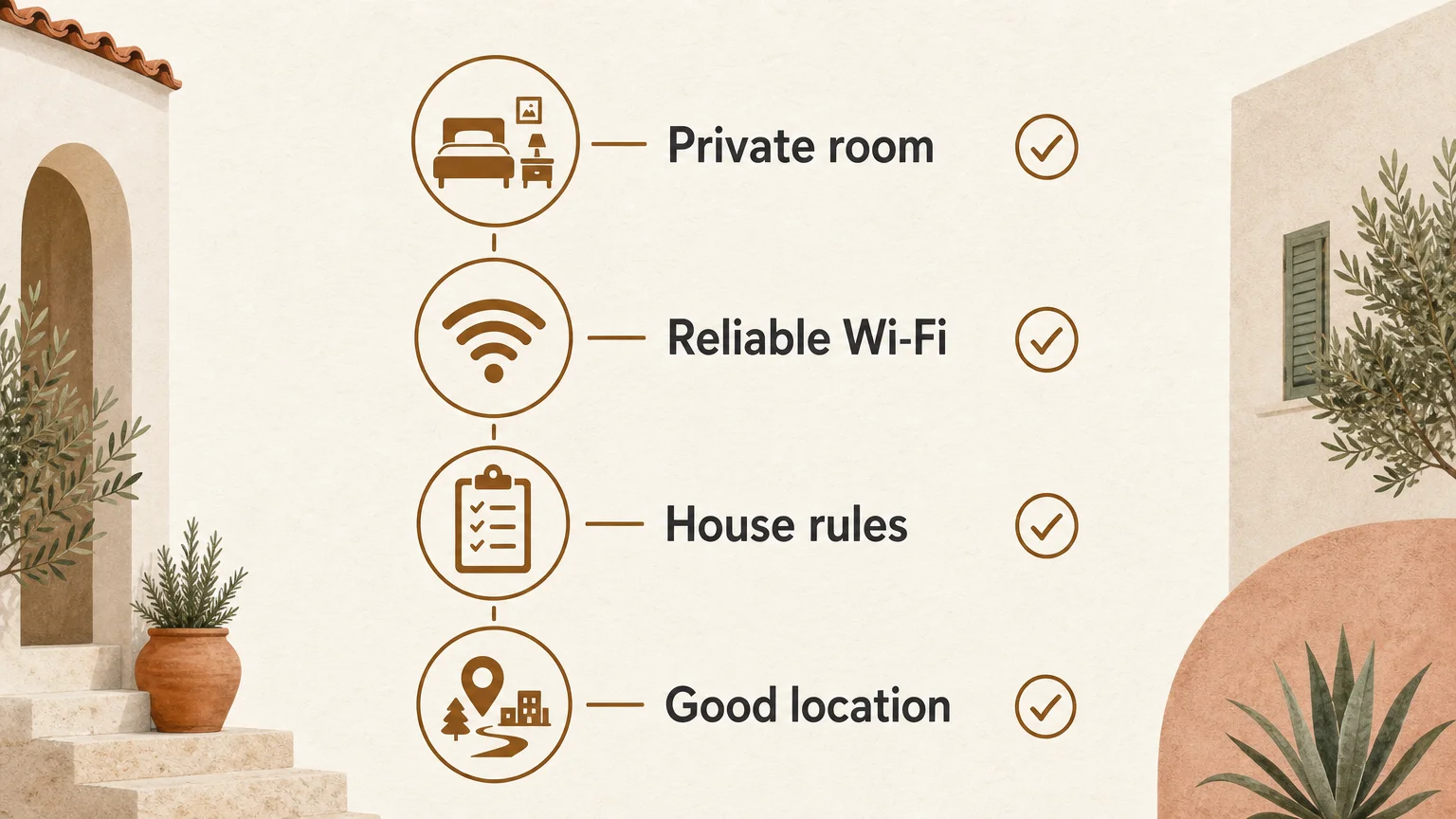
At POMAR, we state the practical conditions of the stay clearly, including room arrangements, coworking access, community activities, and local logistics. Our hosts remain on site, which can be useful when you need help with daily questions, activities, transport, or the shared environment.
Is co-living housing always more affordable?
The answer depends on what you include in the calculation. A room may appear more expensive than an informal house share, yet the total package can include furniture, broadband, utilities, cleaning, work equipment, activities, and local support.
Market estimates also vary because research firms define co-living differently. For example, Grand View Research estimates a global co-living market of $9.4 billion in 2026, while another 2026 forecast places the figure at $10.31 billion. These differences show why you should treat market totals as directional rather than as a precise measure of every shared home.
Your own budget should include the room price, transport, groceries, optional activities, deposits, and any service fees. If you work remotely, also consider the value of a reliable workspace and the cost of recreating it elsewhere. If you travel frequently, include the time and administrative effort saved by arriving at a furnished, managed home.
POMAR publishes indicative accommodation rates for different room types and stay lengths, with separate prices for selected extras such as groceries, transfers, wellness sessions, rentals, and excursions. Because rates and availability can change, review the current booking details before making a decision.
How can you make shared living work well?
Successful co-living depends less on constant social activity than on mutual consideration. You do not need to attend every dinner or become close friends with everyone. You do need to respect quiet periods, clean up after yourself, communicate early, and follow the agreed house rules.
Small habits make a substantial difference. Keep personal belongings within your room, leave shared surfaces ready for the next person, use headphones during calls, and ask before inviting visitors. When a problem appears, raise it calmly with the housemate or community manager instead of allowing frustration to build.
It is also reasonable to protect your own routine. Schedule focused work, identify quiet spaces, and decide when you want social time. The healthiest communities make room for both participation and privacy.
For longer stays, discuss expectations before arrival. Ask how decisions are made, how conflicts are handled, how often shared areas are cleaned, and whether the community changes frequently. These answers reveal more about daily life than promotional photographs.
Choosing the right co-living housing arrangement
Co-living housing can be a practical alternative when you want a furnished room, shared amenities, flexible living, and access to a community. It is particularly useful for people combining work, travel, relocation, and social connection, but it is not a universal replacement for a private apartment.
Before booking, compare the complete cost and read every rule. Confirm privacy, internet quality, location, minimum stay, cancellation terms, and the operator’s approach to community management. The strongest choice is the one that supports your actual routine, not only the lifestyle shown in the photographs.
Take action with POMAR coliving
If you want to combine temporary accommodation with focused work and a welcoming social environment, a hosted coliving setting may give you more structure than an ordinary rental. The right space can help you settle faster, maintain your routine, and explore a new region without arranging every practical detail alone.

At POMAR, we welcome entrepreneurs, freelancers, creatives, digital nomads, and remote workers in private rooms across our Algarve locations. We provide coworking access, high-speed connectivity, ergonomic work areas, on-site hosting, wellness options, community dinners, workshops, and local activities. Learn more about co-living in the Algarve and review the available stay options for your plans.
Frequently Asked Questions
Is co-living housing the same as renting a room with roommates?
They share some features, but co-living is usually more structured and professionally managed. It often includes furnished spaces, shared amenities, community programming, and clearer services than an informal roommate arrangement.
Do co-living homes provide private bedrooms?
Many co-living homes provide private bedrooms with shared kitchens, lounges, bathrooms, gardens, or work areas. Always confirm the room type, bathroom arrangement, storage, and privacy conditions before booking.
Is co-living suitable for remote workers?
It can be suitable when the space provides dependable internet, ergonomic equipment, quiet areas, and room for calls. POMAR combines private-room accommodation with coworking access and work-focused facilities for remote workers and creatives.
What are the main disadvantages of co-living?
The main challenges are reduced privacy, different habits, shared responsibilities, and less control over communal spaces. You should also review visitor rules, noise expectations, cleaning arrangements, and cancellation conditions.
Can families or pets stay in a co-living home?
Policies vary by operator and location. Some standard co-living arrangements restrict children and pets, while private house arrangements or full property privatization may provide more suitable options.